Plate IIArt decoBuying note
Art Deco Chandeliers, Pendants and Wall Sconces: Styles and Buying
How to recognize an art deco chandelier, pendant or sconce, what to check on a vintage fixture, and the ceiling box and bathroom rules for installing one.
We earn from qualifying purchases through links on this page. How we make money.
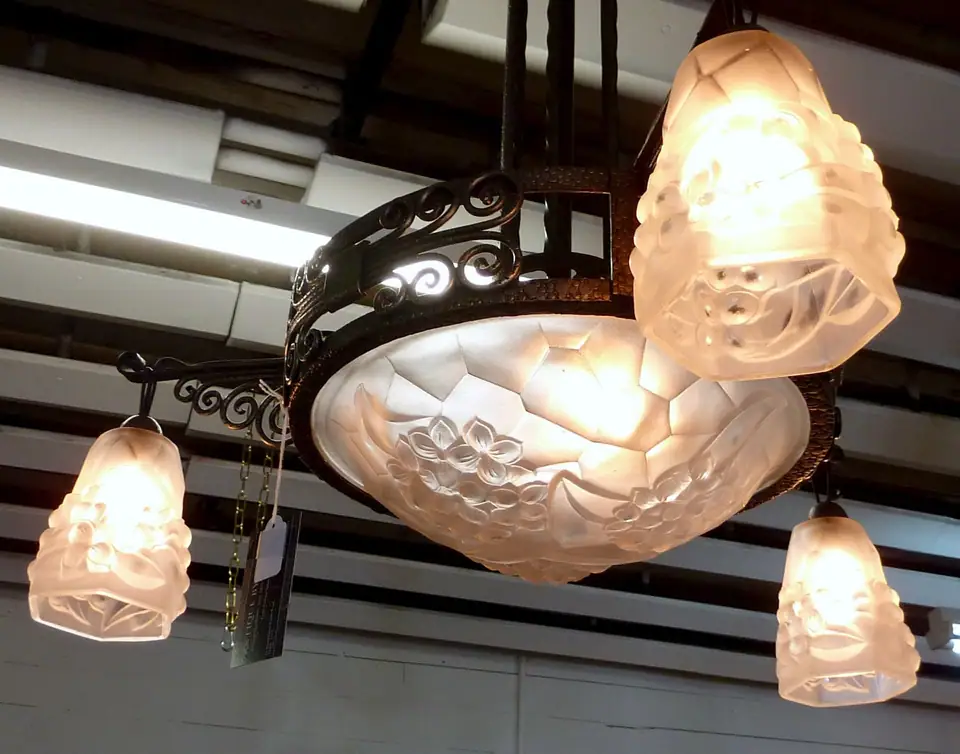
An art deco chandelier, pendant or sconce is geometric rather than floral, and made from the materials of the 1920s and 1930s: frosted, molded or etched glass with wrought iron, chrome, nickel, silvered brass or bronze. Check a vintage fixture’s glass, sockets and canopy, and have a qualified electrician install it on a ceiling box rated for its weight.
Before you plug it in
Ceiling fixtures and sconces are wired into the building, so installation is a job for a qualified electrician. The CPSC warns that “a frayed or cracked cord could cause a shock or fire,” and old fixture wiring deserves the same check. A heavy chandelier also needs a ceiling box rated for its weight, as the section below explains.
What makes a ceiling light art deco?
Geometry and material. The V&A describes art deco, from “the roaring 1920s through to the bust of the Depression-ridden 1930s,” as “playful, luxurious, exotic, geometric, modern.” The Art Story points to the sunburst crowns of the Chrysler Building as a signature American deco motif.
Museum lamps of the period show the materials to look for. Edgar Brandt’s “Temptation” lamps, shown at the 1925 Paris exhibition, pair patinated bronze with etched glass, according to the National Gallery of Victoria. The Metropolitan Museum’s 1927 lamp by Donald Deskey is chrome-plated metal and glass, and its 1928 lamp by Walter von Nessen is silvered brass. The French chandelier pictured above, of about 1925, combines wrought iron with a molded glass bowl and matching glass shades.
Which fixture types will you find?
| Fixture | Where it hangs | What to check on a vintage one |
|---|---|---|
| Chandelier | Center of a room, on a chain or rod | Every arm, socket and shade present; chain links sound |
| Pendant | One shade on a rod, chain or cord | Glass free of cracks; cord or rod not cut short |
| Flush or semi-flush mount | Tight to the ceiling | Glass bowl and the screws or clips that hold it |
| Wall sconce | On the wall, often in pairs | A matching partner, the backplate and the glass |
| Vanity light | Above a bathroom mirror | Whether it is marked for damp locations |
Art deco chandeliers, pendants and flush mounts
Live listings, shown by eBay
Opens eBay in a new tab. Check condition, seller feedback and returns.
The listings mix pre-owned period fixtures and new ones in the style. For a pre-owned fixture, ask the seller for a photo of the canopy and the sockets, and whether it was working when it came down.
What should you check on a vintage chandelier?
The glass first, because it is the hardest part to replace: a lost molded or frosted shade can be difficult to match. Then the metalwork: the canopy that covers the ceiling box, the chain or rod, and the arms. Last, the electrics: sockets, wires and any old cloth-covered wire should be checked or replaced by an electrician before the fixture goes up.
Bulbs matter too. The NIH Office of Research Services says fixtures carry a sticker with the maximum wattage for the bulb; old fixtures that have lost the sticker should get a conservative bulb until an electrician rates the sockets.
How heavy a fixture can a ceiling box hold?
A standard ceiling outlet box has a limit. EC&M explains that under Section 314.27(A)(2) of the National Electrical Code a ceiling box must be able “to support a luminaire weighing a minimum of 50 lb.” A fixture heavier than 50 pounds must be supported independently of the box, unless the box “is listed for the weight to be supported” and marked inside with the maximum weight.
Weigh a large vintage chandelier, or ask the seller for its weight, before you plan the installation, and give the figure to your electrician.
Art deco sconces and vanity lights
Sconces are the easiest deco fixture to live with: they light a hallway or flank a mirror without a ceiling box. If you want a matched pair, buy them together: finding a partner for a single sconce later can be hard.
Bathrooms have their own rules. EC&M’s summary of the code says fixtures within the tub or shower area up to 8 feet above the rim “must be marked for damp locations,” and those in shower spray must be marked for wet locations. Hanging fixtures cannot sit within 3 feet horizontally and 8 feet vertically of the tub rim. Check any vintage vanity light for such a marking; if it has none, use it outside that zone or choose a new, rated fixture.
Art deco wall sconces and vanity lights
Live listings, shown by eBay
Opens eBay in a new tab. Check condition, seller feedback and returns.
For plug-in lamps, see the art deco table and floor lamp guide. For later ceiling lights, see the mid-century guide, and for old wiring, the rewiring guide. Back to the art deco lighting guide.
Frequently asked questions
How do I identify an art deco chandelier?
Look at the shape and the materials. Deco fixtures are geometric rather than floral, with frosted, molded or etched glass and metals such as wrought iron, chrome, nickel or silvered brass. Then check for a maker's mark and ask the seller for the fixture's history.
Can any ceiling box hold a chandelier?
No. EC&M explains that under NEC Section 314.27(A)(2) a ceiling outlet box must support a fixture of at least 50 pounds; a heavier fixture needs independent support unless the box is listed for the weight and marked inside.
Can I put an art deco light in a bathroom?
Only a fixture marked for the location. EC&M's summary of the NEC says fixtures within the tub or shower area up to 8 feet above the rim must be marked for damp locations, and wet locations if they are in shower spray. Hanging fixtures cannot be within 3 feet horizontally and 8 feet vertically of the tub rim.
Should I buy a pair of vintage sconces?
If you want them to match, yes: a period pair is harder to assemble later than to buy together. Check that both have the same glass, finish and backplate.
Who should install a vintage chandelier?
A qualified electrician, who can also check or replace the old wiring and confirm the ceiling box is rated for the weight.
Sources
- Art DecoVictoria and Albert Museum
- Art Deco movement overviewThe Art Story
- Temptation, standard lamp (La Tentation, torchère)National Gallery of Victoria
- Table Lamp, Donald Deskey, 1927The Metropolitan Museum of Art
- Table Lamp, Walter von Nessen, 1928The Metropolitan Museum of Art
- French Art Deco Wrought Iron and Art Glass ChandelierWikimedia Commons
- A Weighty IssueEC&M
- Stumped by the Code? NEC Requirements of Luminaires Installed in Wet, Damp, or Corrosive LocationsEC&M
- CPSC and NESF Urge Consumers to "Plug Into Electrical Safety"U.S. Consumer Product Safety Commission
- Be Fire Safe with ElectricityNIH Office of Research Services
Collection: Art decoIntroduction: Art Deco Lighting: How to Recognize and Buy 1920s and 1930s Lamps
Nearby in the catalogue
The whole cataloguePlate I
Art Deco Lighting: How to Recognize and Buy 1920s and 1930s Lamps
Photo: Francisco Anzola / Wikimedia Commons, CC BY 2.0Plate XI
Plate III
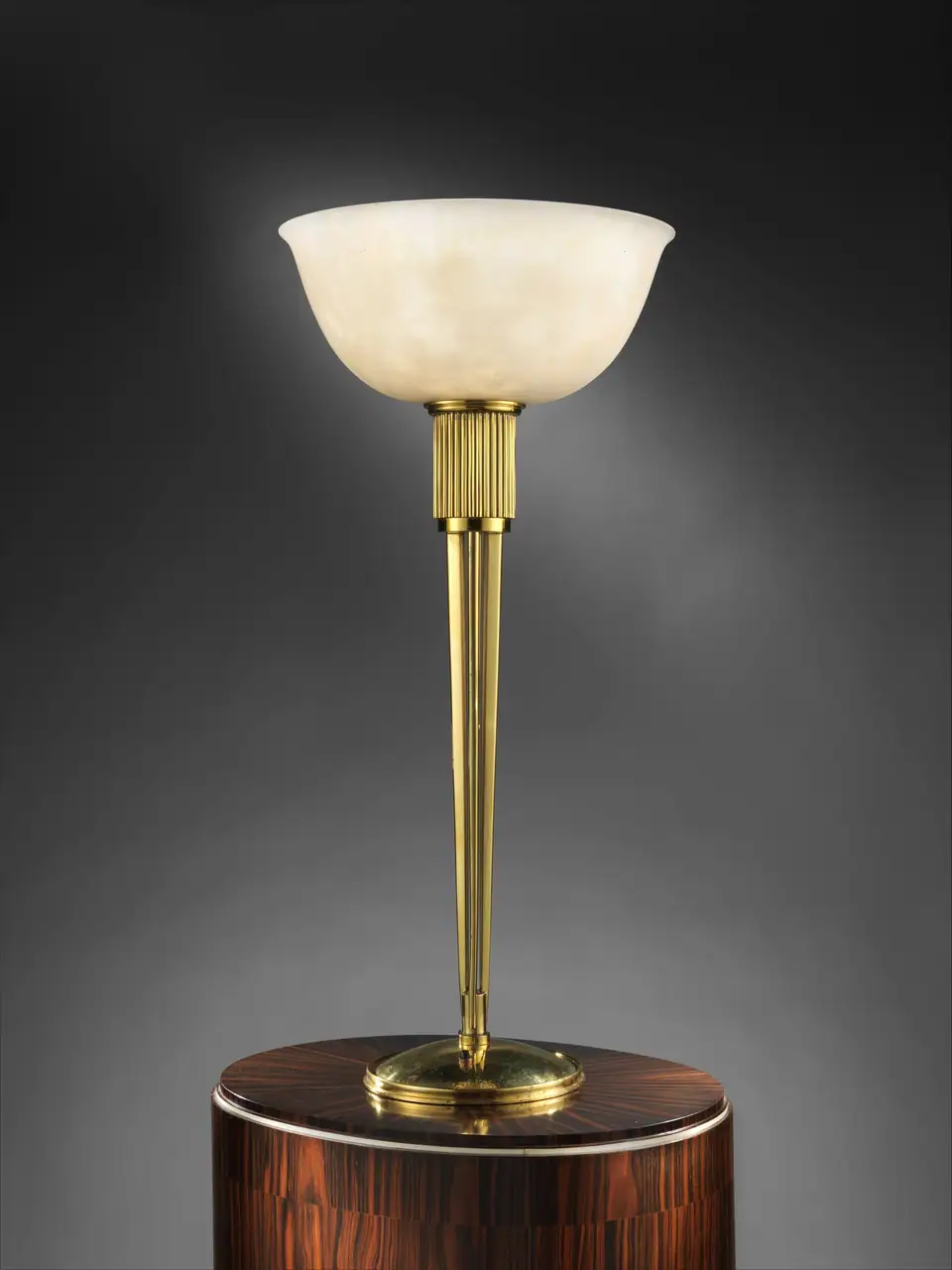
Plate IX