Plate IIIArt decoSurvey
Art Deco Table and Floor Lamps: Torchieres, Figural and Slag Glass
Art deco table, desk and floor lamps explained through museum pieces: torchieres, figural lamps such as Frankart, slag glass lamps, and how to buy one.
We earn from qualifying purchases through links on this page. How we make money.
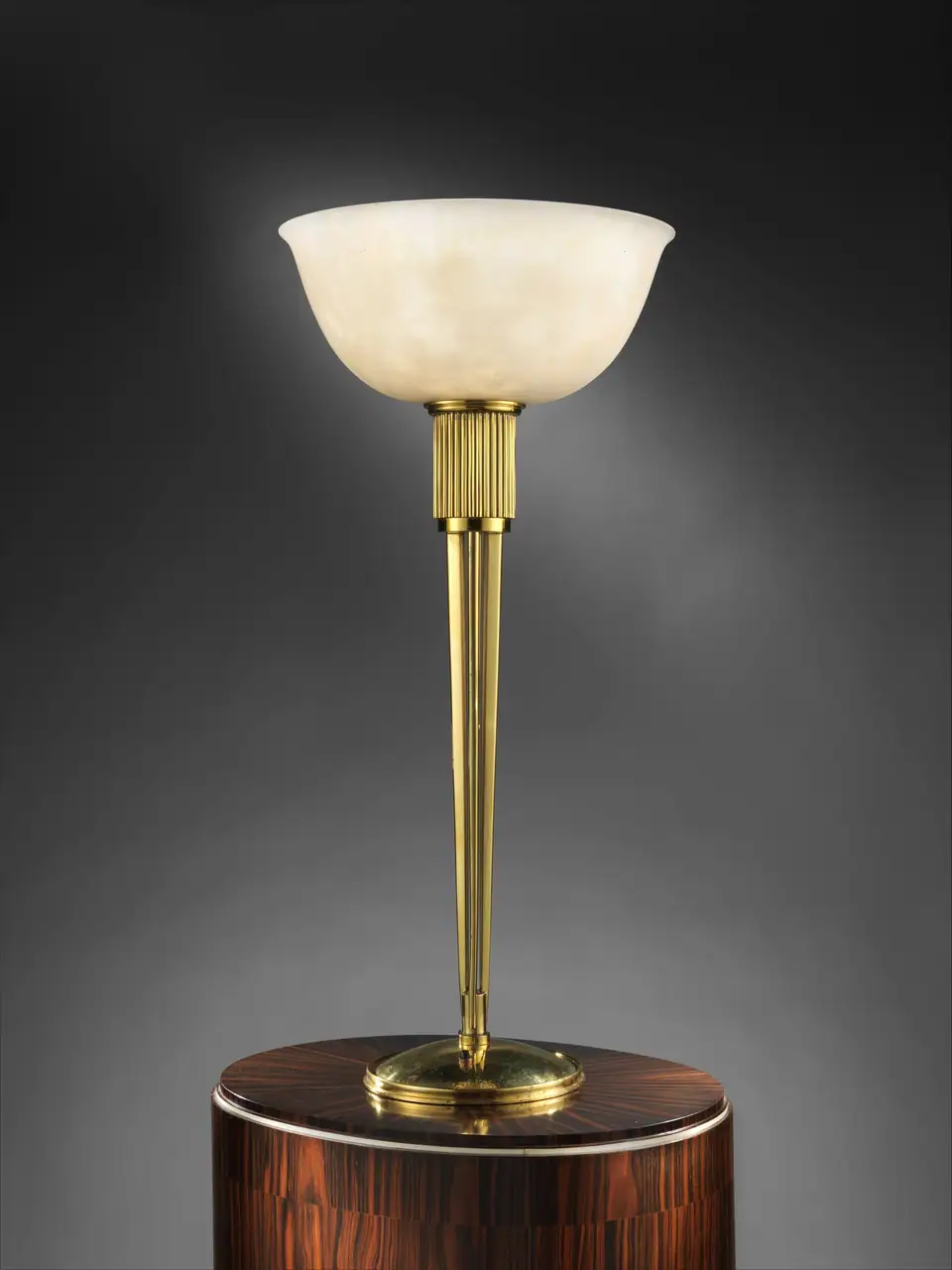
Art deco table and floor lamps come in four families: geometric table and desk lamps in chrome, silvered brass or bronze; torchieres that throw light upward; figural lamps with a sculpted figure, such as Frankart’s; and slag glass panel lamps. Museum pieces from 1925 to 1930 show the period’s materials.
Which lamps define art deco?
The museum pieces below are the benchmark for what a period lamp looks like. Each record lists the maker, date and materials.
| Lamp | Designer or maker | Date | Materials (museum record) |
|---|---|---|---|
| Lamp (pictured) | Jacques-Emile Ruhlmann | About 1926 | Gilt bronze and alabaster, 29 1/2 in. tall (the Met) |
| “Temptation” torchère | Edgar Brandt, with Verrerie de Nancy | About 1925 | Etched glass, patinated bronze (NGV) |
| Table lamp | Donald Deskey | 1927 | Chrome-plated metal, glass (the Met) |
| Table lamp | Walter von Nessen | 1928 | Silvered brass, paper (the Met) |
| Standing lamp | Jules Bouy | About 1930 | Steel, glass (the Met) |
The pattern is clear across the table: metal treated as a finish in itself (gilt, chrome, silver, patina), glass or stone that diffuses rather than shows the bulb, and strong, simple shapes.
Art deco table, desk and floor lamps
Live listings, shown by eBay
Opens eBay in a new tab. Check condition, seller feedback and returns.
The listings mix pre-owned period lamps and new lamps in the style. Look for a date and maker in the listing; “art deco style” means a newer piece.
Torchieres: the deco floor lamp
A torchiere stands tall and throws its light upward, off the ceiling. Edgar Brandt’s “Temptation” lamps are an example from the 1925 Paris exhibition: the National Gallery of Victoria says they were made in two designs and two sizes, “a tablelamp and a standard lamp,” between 1920 and 1926, with a patinated bronze serpent holding a conical etched glass shade.
Later torchieres brought a hazard of their own. In 1996 the CPSC warned that the tubular bulbs in most torchiere-style halogen lamps reach temperatures “ranging from about 970 degrees Fahrenheit for a 300 watt tubular halogen bulb to 1,200 degrees Fahrenheit for a 500 watt” bulb, and could start a fire in nearby curtains or clothing.
Before you plug it in
Check the bulb type on any torchiere. The CPSC advises never placing a halogen torchiere where its bulb could touch curtains, never draping clothes over one, and never leaving one on in an empty room. On any vintage lamp, the CPSC warns that “a frayed or cracked cord could cause a shock or fire”; have old wiring checked or replaced, as the rewiring guide explains.
Figural lamps and Frankart
Figural lamps set a sculpted figure beside or beneath the shade, and in American deco the best-known name is Frankart. Harry L. Rinker’s collectibles column says Arthur von Frankenberg’s designs centered on the female form, and that his company made lamps, bookends, ashtrays, clocks and more. Frankart Inc. was incorporated in 1924, headquartered in Manhattan, and ceased operations in 1935.
A Skinner auction entry for two Frankart lamps of about 1930 describes “verdigris patinated metal,” with molded marks reading “Frankart Inc. Pat. Appld. For” and a design patent number. Look for such a mark on the base; an unmarked figure may be another maker’s work or a later copy.
Desk lamps
Deco designers treated the desk lamp as a design piece too. The Met’s Donald Deskey table lamp of 1927, in chrome-plated metal and glass, is small enough for a desk at about 12 inches tall. For the green-shaded bankers lamp, which predates deco, see the schoolhouse and bankers lamp guide.
Slag glass lamps
Slag glass turns up in the shades of many antique table lamps. The Corning Museum of Glass calls slag glass “a collectors’ name for opaque pressed glass with colored streaks, usually white and/or cream streaks,” sold in its day as “Marble glass” or “Brown malachite.” Collectors Weekly notes that it “was a popular material for lampshades.”
Not every slag glass lamp is art deco: slag glass is a material, not a style. Makers such as Handel (founded 1885) and Bradley & Hubbard (founded 1852), both of Meriden, Connecticut, were in business long before the deco years. The antique lamp value guide covers how to identify them.
Antique slag glass and leaded lamps
Live listings, shown by eBay
Opens eBay in a new tab. Check condition, seller feedback and returns.
Period lamp or new lamp in the style?
Both have a place. A period lamp carries its maker, its date and its original finish; it is the choice for a collector, and it usually needs new wiring. A new lamp in the deco style gives the look with a modern cord and socket and costs less to own day to day.
Listings do not always make the difference plain. Read the description for a date, a maker and the word “style”: a lamp described as “art deco style” is a newer piece. Ask for photos of the underside of the base and any label, and for the height and shade size in inches so you can compare it with the museum pieces above. Our antique lamp value guide explains what those marks can tell you.
How to choose an art deco lamp
- Period or reproduction. A period lamp has a maker, a date and wear to match; a new lamp in the style should be priced and described as one.
- Height and shade. The Ruhlmann lamp stands 29 1/2 inches; a desk lamp like Deskey’s about 12. Measure the table and the space above it.
- Light direction. A torchiere lights the ceiling and the room; a table lamp lights the surface below it.
- Wiring. Plan on a new cord for any lamp that still has its original one.
For fixtures that hang, see the chandelier and sconce guide. Back to the art deco lighting guide.
Frequently asked questions
What is a torchiere lamp?
A tall floor lamp that throws its light upward from a bowl or cone at the top. The National Gallery of Victoria's Edgar Brandt lamp of about 1925 is catalogued as a torchère.
Are halogen torchiere lamps safe?
The CPSC warned in 1996 that the tubular halogen bulbs in most torchiere-style lamps can reach about 970 to 1,200 degrees Fahrenheit and could start a fire. It advised keeping them away from curtains and never leaving one on in an empty room.
What is a Frankart lamp?
An art deco figural lamp or bookend from Frankart Inc. of New York, incorporated in 1924 and closed in 1935, according to Harry L. Rinker. Pieces carry molded marks such as "Frankart Inc. Pat. Appld. For."
Is a slag glass lamp art deco?
Not necessarily. Slag glass is a type of opaque, streaked pressed glass used in lamp shades, not a style. Judge the frame's design and any maker's mark.
What should I check on a vintage art deco lamp?
The maker's mark, the condition of glass and metal finish, and the wiring. The CPSC warns that a frayed or cracked cord could cause a shock or fire, so plan to have an old cord replaced.
Sources
- Lamp, Jacques-Emile Ruhlmann, about 1926 (Met 1985.430.21ab)The Metropolitan Museum of Art (via Wikimedia Commons)
- Temptation, standard lamp (La Tentation, torchère)National Gallery of Victoria
- Table Lamp, Donald Deskey, 1927The Metropolitan Museum of Art
- Table Lamp, Walter von Nessen, 1928The Metropolitan Museum of Art
- Standing lamp, Jules Bouy, about 1930The Metropolitan Museum of Art
- Rinker on Collectibles, column 1307Harry L. Rinker
- Two Frankart Figural Lamps (auction 3325B, lot 311)Skinner Auctioneers
- What is slag glass?Corning Museum of Glass
- Antique Slag Glass LampsCollectors Weekly
- Handel (maker record)University Museums, Iowa State University
- Illuminating Connecticut's Past: The Bradley & Hubbard LegacyConnecticutHistory.org (CT Humanities)
- CPSC Issues Warning on Tubular Halogen BulbsU.S. Consumer Product Safety Commission
- CPSC and NESF Urge Consumers to "Plug Into Electrical Safety"U.S. Consumer Product Safety Commission
Collection: Art decoIntroduction: Art Deco Lighting: How to Recognize and Buy 1920s and 1930s Lamps
Nearby in the catalogue
The whole cataloguePlate I
Art Deco Lighting: How to Recognize and Buy 1920s and 1930s Lamps
Photo: Francisco Anzola / Wikimedia Commons, CC BY 2.0Plate XI
Plate II
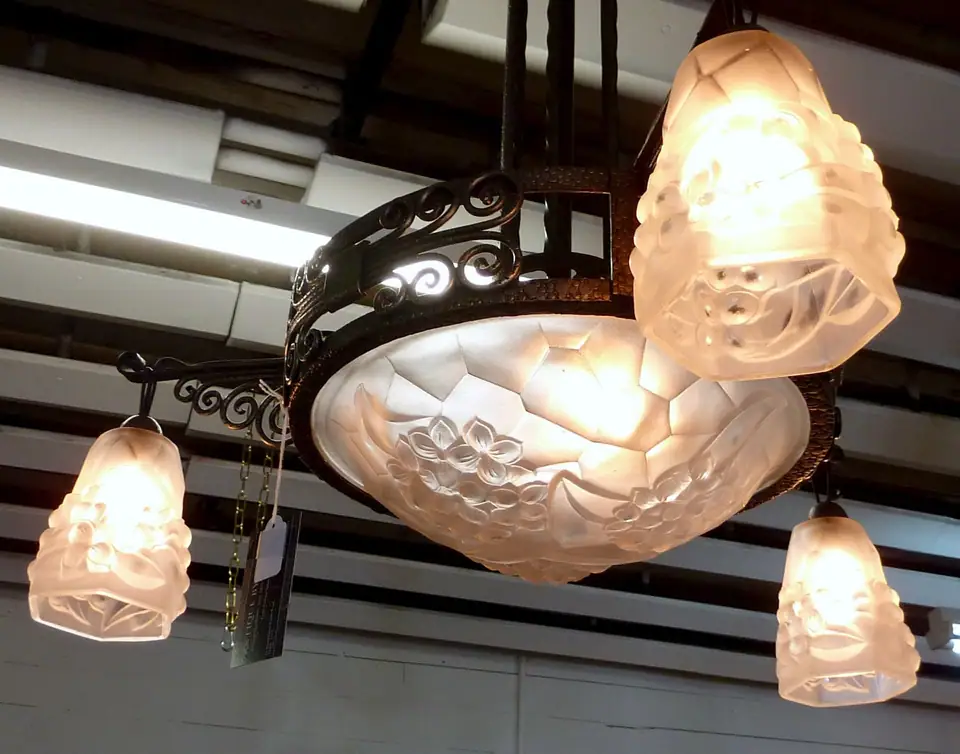
Plate IX