Plate XValue, care and wiringBuying note
Rewiring an Antique Lamp: When to DIY and When to Call a Pro
Signs an old lamp needs a new cord, socket or plug, what a rewiring kit holds, when to call a pro, and how to choose bulbs and shade fitters for a vintage lamp.
We earn from qualifying purchases through links on this page. How we make money.
Rewire an antique lamp when its cord is frayed, cracked or stiff, when the plug has two equal blades, or when the socket is loose or scorched. Replacement parts are standard. If you are unsure, or the fixture is hardwired into a wall or ceiling, hand it to a lamp repair shop or a qualified electrician.
Before you plug it in
The CPSC warns that “a frayed or cracked cord could cause a shock or fire”, and tells owners to check that every bulb is the correct wattage for its fixture. If an outlet or switch feels unusually warm, stop using it and have a qualified electrician check the wiring. Chandeliers, sconces and other hardwired fixtures are a job for a qualified electrician, not a kit.
How do you know an old lamp needs rewiring?
A lamp from the 1920s to the 1960s may still have its original cord and socket, so look it over before you plug it in. The table puts each warning sign next to what the source says about it.
| Sign | Why it matters | Source |
|---|---|---|
| Frayed, cracked or stiff cord | “Could cause a shock or fire” | CPSC, 2000 |
| Cord run under a rug | Rugs “prevent heat from being released by the cord” | CPSC, 1990 |
| Bulb above the marked wattage | Overheating “that could lead to a fire” | CPSC, 2000 |
| Plug with two equal blades | Not polarized: no wide blade to keep current off metal parts | Antique Lamp Supply glossary |
| Warm outlet or switch | “An unsafe wiring condition could exist” | CPSC, 2000 |
Sockets have limits too. Antique Lamp Supply says every socket carries a maximum wattage rating, and that a 100-watt bulb in a 60-watt fixture “will draw more power through the wires than they are designed to handle”, which risks fire and damages the socket and wiring. If the socket has no readable rating, the NIH Office of Research Services advice applies: match the bulb to the maximum on the fixture’s sticker.
What is in a lamp rewiring kit?
A kit replaces the parts that carry current. Antique Lamp Supply’s glossary defines each one:
- Cord: the cable that carries electricity from the wall outlet to the lamp.
- Socket: the part that holds the bulb and connects it to the cord’s wires. Grand Brass calls the E26 medium base “the most commonly used style” in homes.
- Polarized plug: a plug with one blade wider than the other.
- UL knot (Underwriter’s knot): a knot tied in the two wires inside the socket that relieves strain on the screw terminals.
For the cord, the CPSC’s advice on replacement cords is a useful test: choose one that carries “the certification label of an independent testing laboratory”. UL Solutions says its mark means a product “has been certified to meet scientific safety, quality or security standards.”
Rewiring kits, sockets, harps and bulbs
Live listings, shown by eBay
Opens eBay in a new tab. Check condition, seller feedback and returns.
These listings are new parts only. Check the listing for a certification mark on the cord and the socket’s wattage rating before you buy.
Should you rewire it yourself or call a pro?
This guide gives no wiring steps: none of our sources is a step-by-step manual, and a mistake here is a fire risk. Use this rule of thumb instead.
A simple plug-in table or floor lamp with one socket is the kind of repair lamp parts suppliers sell kits for. If you have not done it before, or the lamp has several sockets, a switch in the base or a rare signed shade, take it to a lamp repair shop. If the lamp may be valuable, ask the shop to return any original parts it replaces; our antique lamp value guide explains what buyers look for.
Anything wired into the building is different. Chandeliers, pendants, flush mounts and sconces need a qualified electrician, and a heavy fixture needs a ceiling box rated for its weight. The chandelier and sconce guide covers that rule.
Which bulbs suit an antique lamp?
Shop by lumens, not watts. The FTC’s bulb guide says lumens measure brightness, and that a traditional 60-watt incandescent gives about 800 lumens while an LED giving the same light “uses only about 9 watts.” That margin matters in an old socket rated for 40 or 60 watts.
Color is on the same box. The FTC’s Lighting Facts label shows where a bulb falls “on the warm (more yellow) to cool (more blue) range”, on a scale from 2,600 K to 6,600 K. Amber slag glass and green bankers shades were made in the incandescent era, so a bulb from the warm end of the scale is the closer match to the light they were designed for.
Vintage-style LED filament bulbs fit the same E26 sockets. Read the lumens and the color on the Lighting Facts label rather than the “equivalent” wattage alone.
How do lamp shades attach: harps, spiders and UNO fitters
A new shade has to match the lamp’s fitter. Most American table lamps use one of three.
| Fitter | How it holds the shade | Source |
|---|---|---|
| Spider (on a harp) | The shade’s washer-shaped ring rests on top of the harp and a finial screws on | Lux Lampshades |
| UNO | “The shade slides over the socket, and a ring screws on”; no harp, no finial | Lux Lampshades |
| Clip-on | Clips directly onto the bulb | Lux Lampshades |
Grand Brass describes a harp as two parts: a saddle that mounts below the socket and a removable frame “available in multiple heights”, so you can raise or lower a shade without changing it. Schoolhouse pendants use a different system, a glass shade held by its fitter lip; the schoolhouse and bankers lamp guide covers those sizes.
For the lamps themselves, start with the art deco lighting guide or the table and floor lamp guide.
Frequently asked questions
Can I plug in an antique lamp before rewiring it?
Only after checking it. The CPSC says a frayed or cracked cord could cause a shock or fire, so look over the whole cord, the plug and the socket first. If anything is cracked, brittle or scorched, have it rewired before use.
What is a polarized plug?
A plug with one blade wider than the other. Antique Lamp Supply explains that the design helps keep electricity from leaking to the metal parts of the fixture. Many rewiring kits come with one.
What wattage bulb can I use in a vintage lamp?
No more than the maximum marked on the lamp or socket. The NIH Office of Research Services says fixtures carry a sticker with the maximum wattage, and the CPSC says to replace any bulb above the recommended wattage to prevent overheating.
Do LED bulbs work in old lamps?
An LED with an E26 medium base fits the standard American lamp socket. The FTC notes that an LED producing the 800 lumens of a 60-watt incandescent uses about 9 watts. The Lighting Facts label shows whether the light is warm (more yellow) or cool (more blue).
Who should rewire a chandelier?
A qualified electrician. Chandeliers and sconces are wired into the building, and the ceiling box has to carry the fixture's weight. Our chandelier guide explains the box rating.
Sources
- CPSC and NESF Urge Consumers to "Plug Into Electrical Safety"U.S. Consumer Product Safety Commission
- Limit Extension Cords To Reduce Risk Of FireU.S. Consumer Product Safety Commission
- Be Fire Safe with ElectricityNIH Office of Research Services
- Look for the UL safety Mark before you buyUL Solutions
- Shopping for Light BulbsFederal Trade Commission
- The FTC "Lighting Facts" Label: Questions and Answers for ManufacturersFederal Trade Commission
- Electrical Lamp Hardware GlossaryAntique Lamp Supply
- Determining the Necessary WattagesAntique Lamp Supply
- Lamp Shade HarpsGrand Brass Lamp Parts
- E-26 Base Lamp SocketsGrand Brass Lamp Parts
- The Complete Guide to Lampshade FittersLux Lampshades
Collection: Value, care and wiringIntroduction: Art Deco Lighting: How to Recognize and Buy 1920s and 1930s Lamps
Nearby in the catalogue
The whole cataloguePlate I
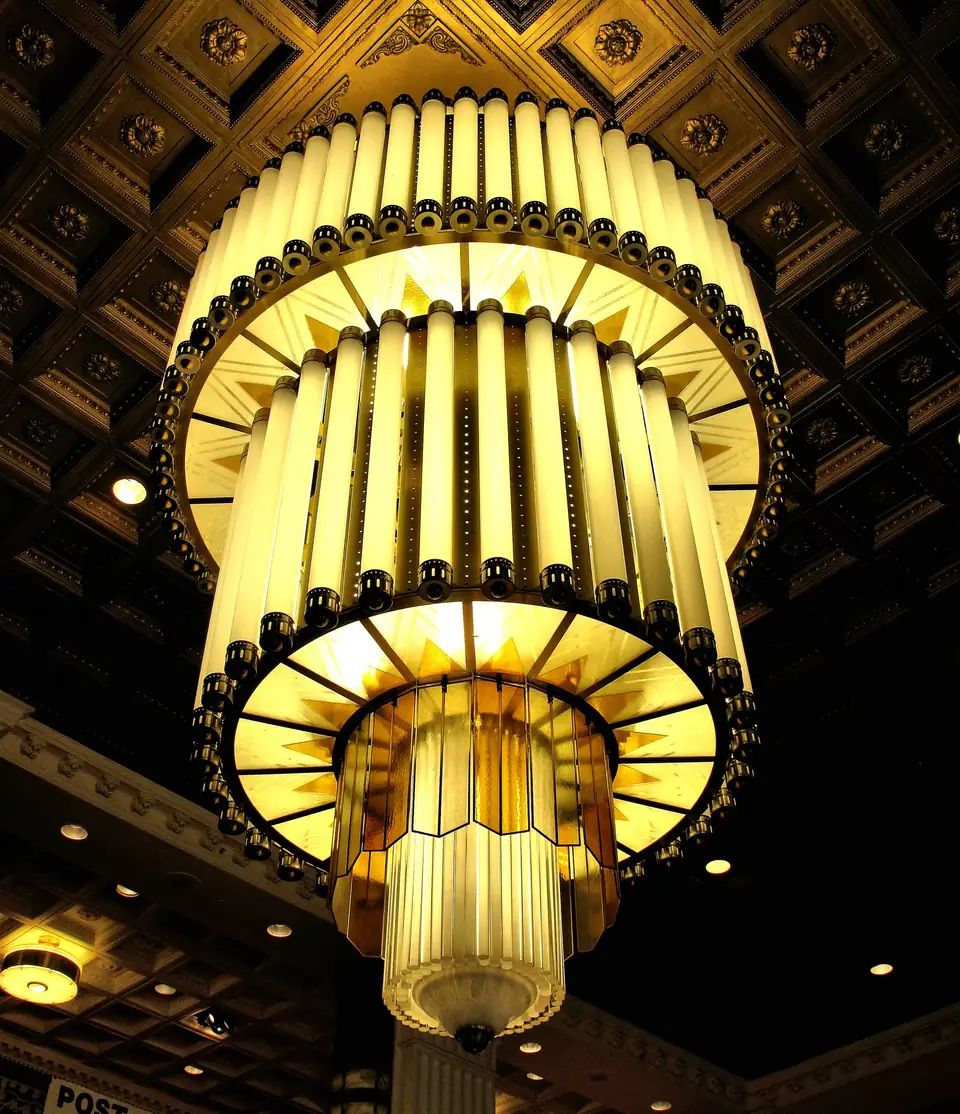
Art Deco Lighting: How to Recognize and Buy 1920s and 1930s Lamps
Photo: Francisco Anzola / Wikimedia Commons, CC BY 2.0Plate IX
Plate XI
Plate II