Plate VIIIOther erasBuying note
Schoolhouse Lights and Bankers Lamps: Early 1900s Designs Today
Where the green bankers lamp came from, how to date an Emeralite, how schoolhouse shades and fitters are sized, and how to buy either new or vintage.
We earn from qualifying purchases through links on this page. How we make money.
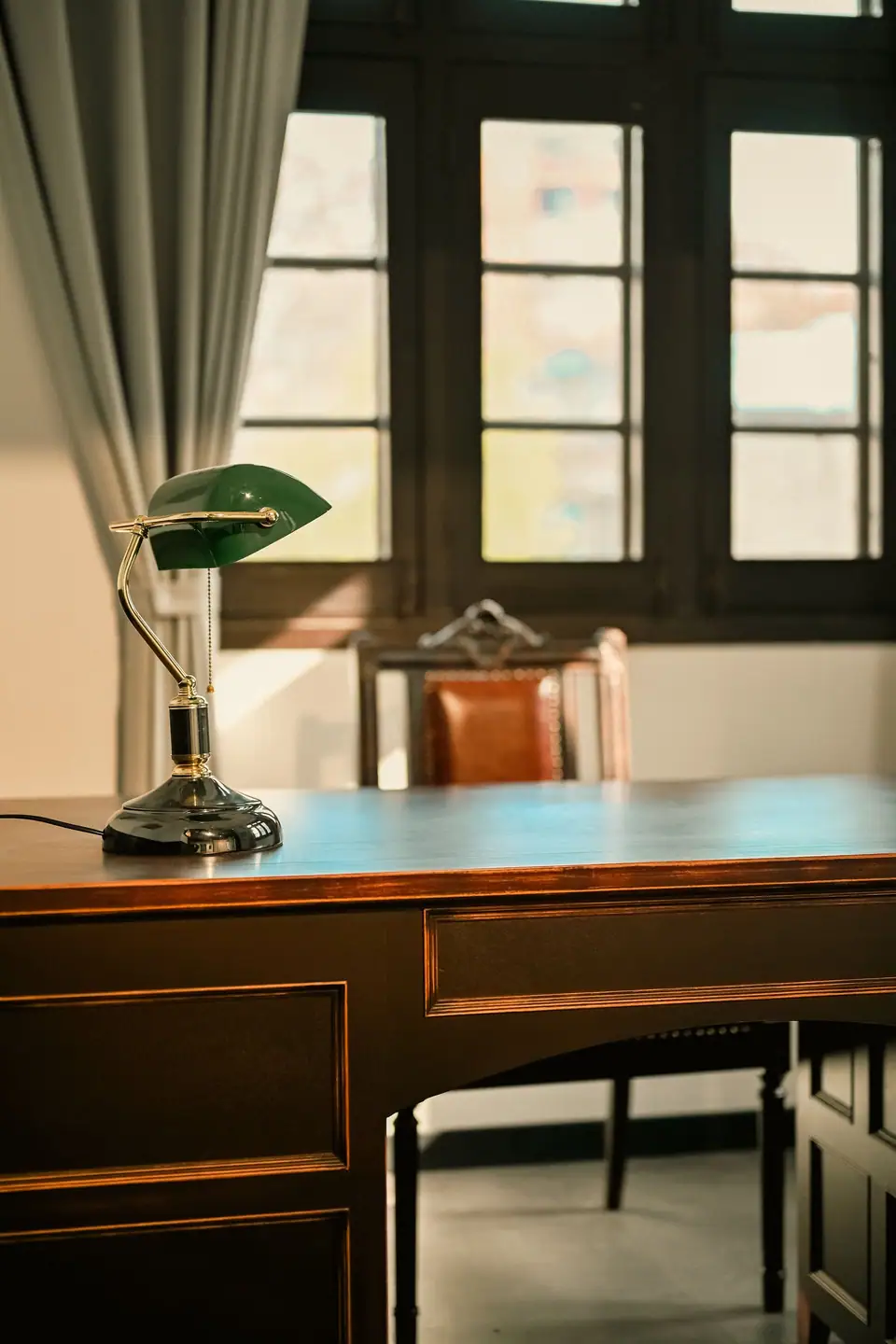
Bankers lamps and schoolhouse lights are two early 1900s designs still made today. The green-shaded desk lamp traces to the Emeralite, first made in 1909 by H.G. McFaddin & Co. in New York; the schoolhouse light is a white opal glass shade on a pendant or flush mount. Both sell new and vintage, and both need a shade that fits.
Where did the green bankers lamp come from?
From one company’s product line. The collector history at emeralite.com says the first Emeralite lamp “as we know it today” was made in 1909, the year Harrison D. McFaddin’s design for lamp shades was approved on May 11. The name came from the shade: white opal glass on the inside, cased in a layer of green on the outside.
The same history says the shades were made in Moravia, in today’s Czech Republic, and adds that it is “believed” all of them came from the J. Schreiber & Neffen glassworks at Rapotin. Treat that detail as the collectors’ view, not a settled fact.
How do you date an Emeralite bankers lamp?
By its series. The Emeralite history divides production into four periods, with dates it calls approximate because older parts stayed on sale for years.
| Series | Years (approximate) | How to recognize it |
|---|---|---|
| 4378 | 1909 to 1916 | Shade has a hole on each side, where it swiveled on the arm |
| 8734 | 1916 to the early 1930s | No holes; shade clamps into a channel on an armature patented August 15, 1916 |
| No. 9 | Early 1930s, about five years | Wider shades, 10 and 12 inches instead of 8 1/2, with two bulbs |
| Late | Late 1930s, about 20 years | Mostly fluorescent, mostly metal shades; little collector interest |
Signatures help too. The history says almost every Emeralite shade was signed, with a silver ink stamp, a rectangular decal about two inches wide or a round decal. The same company’s Bellova line, from February 1923, came in other colors and painted finishes.
Bankers lamps: green glass, brass and Emeralite
Live listings, shown by eBay
Opens eBay in a new tab. Check condition, seller feedback and returns.
The listings include new bankers lamps and pre-owned ones. A vintage Emeralite is a 100-year-old electrical object, so read the callout below before you use one.
Before you plug it in
The CPSC says “a frayed or cracked cord could cause a shock or fire,” and to check that every bulb is the correct wattage for its fixture. Have the cord and sockets of a vintage lamp checked or replaced before daily use; the rewiring guide explains the parts.
What is a schoolhouse light?
A plain glass shade, often white opal glass, hung as a pendant or mounted close to the ceiling. Antique Lamp Supply sells a shade it describes as an “Early 20th Century Schoolhouse style pendant shade,” 8 inches wide and 6 inches tall with a 4 inch lip fitter. That one product shows the three numbers every schoolhouse buyer needs: width, height and fitter.
How are schoolhouse shades sized?
By the fitter. The Grit and Polish, a renovation blog, defines the fitter as “the outer diameter of the top lip of a shade,” the part that slides into the fixture and is held by screws. It lists common fitter sizes of 2 1/4, 3 1/4, 4, 6, 8, 10 and 12 inches, and advises taking the old shade down and measuring across its top rather than trying to measure it in place.
| Measurement | Where to take it | Why it matters |
|---|---|---|
| Fitter | Outside of the shade’s top lip | Must match the fixture’s shade holder |
| Width | Widest point of the shade | Sets the pool of light and the look |
| Height | Top lip to bottom edge | Check the clearance above a table or in a hallway |
A vintage shade can go on a new fixture, and a new shade on a vintage one, as long as the fitter matches. The same blog notes that shades “aren’t proprietary to any brand of fixture.”
Schoolhouse pendants, flush mounts and globe shades
Live listings, shown by eBay
Opens eBay in a new tab. Check condition, seller feedback and returns.
New or vintage?
Buy vintage for the object itself: an early signed Emeralite or an original schoolhouse fixture with its canopy. Buy new for daily light with a modern cord and socket. Either way, choose the bulb by lumens: the FTC says a 60-watt incandescent gives about 800 lumens, which an LED matches at about 9 watts.
Schoolhouse pendants and flush mounts are wired into the ceiling, so they are a job for a qualified electrician; the chandelier and ceiling light guide covers the ceiling box.
What about piano lamps?
They are the bankers lamp’s older cousin: a lamp built to aim light at one task. A Victorian brass piano lamp described by Islington’s Object Lessons collection placed a brass bowl around half of an oil lamp so the light reflected onto the sheet music, and some such lamps attached to the piano itself.
For desk lamps from the next decades, see the art deco table and floor lamp guide. For a gift, the reader and the home-office worker both appear in our lighting gift guide. Back to the art deco lighting guide.
Frequently asked questions
Why are bankers lamps green?
The classic shade comes from the Emeralite line, named for its green cased glass. According to the collector history at emeralite.com, the shades were white opal glass inside with a layer of green outside.
How do I know if my bankers lamp is a real Emeralite?
Look for the signature. The Emeralite history says almost every shade was signed with a silver ink stamp, a rectangular decal about two inches wide or a round decal. Shades with a hole on each side belong to the earliest series, from 1909 to 1916.
What is a schoolhouse light?
A pendant or flush-mount fixture with a white opal glass shade, a style from the early 1900s. Antique Lamp Supply still sells an early 20th century schoolhouse-style shade, 8 inches wide with a 4 inch fitter.
How do I measure a schoolhouse shade fitter?
Measure across the outside of the shade's top lip, the part that slides into the fixture and is held by screws. Common sizes run from 2 1/4 to 12 inches.
What is a piano lamp?
A lamp built to direct light onto sheet music. A Victorian example described by Islington's Object Lessons used a brass shade around half the lamp to aim and strengthen the light.
Sources
- History of Bellova and Emeralite lampsEmeralite.com (collector history)
- How to Replace a Light Fixture's Glass ShadeThe Grit and Polish
- 8" Opal Schoolhouse Shade, 4 inch lip fitter (08840)Antique Lamp Supply
- Piano Lamp, Victorian, OriginalObject Lessons, Islington Education Library Service
- CPSC and NESF Urge Consumers to "Plug Into Electrical Safety"U.S. Consumer Product Safety Commission
- Shopping for Light BulbsFederal Trade Commission
Collection: Other erasIntroduction: Art Deco Lighting: How to Recognize and Buy 1920s and 1930s Lamps
Nearby in the catalogue
The whole cataloguePlate I
Art Deco Lighting: How to Recognize and Buy 1920s and 1930s Lamps
Photo: Francisco Anzola / Wikimedia Commons, CC BY 2.0Plate VI
Plate VII
Plate IX